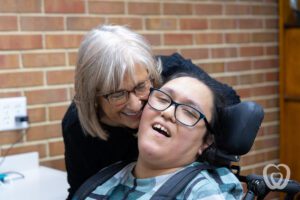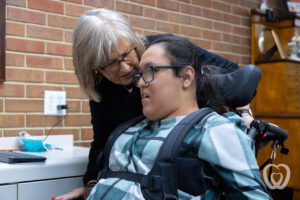
When Stephanie Coleman’s son, Matthew, was diagnosed with autism at age 13, she found herself entering an unfamiliar world without a map. “We were always behind the eight ball,” she said. “Every bit of information we got—whether it was about IEPs, waiver services, or college supports—came after the fact.”
That sense of always catching up became the driving force behind her lifelong advocacy. Today, Stephanie serves as the Family Discipline Mentor for the Kansas Leadership Education in Neurodevelopmental and Related Disabilities (LEND) program at the University of Kansas Medical Center. Through her work, she helps ensure other families don’t have to walk the same confusing road alone.
From Parent to Policy Advocate
Stephanie’s path to LEND began with her son’s journey. After years of navigating school systems, disability services, and college applications, she realized how much families could benefit from clear guidance and support. “I just wanted to help families not be in the same boat I was,” she said.
Her frustration with the system led her to share her story with state and federal policymakers. “I told our story probably 22 times,” she laughed. “But every time, I hoped it might help change the system for someone else.”
When she joined LEND as a family trainee in 2016, she found her true calling. What began as a one-year training opportunity turned into a career focused on empowering families, educating professionals, and strengthening the workforce that serves people with disabilities.
What Is LEND?
LEND—short for Leadership Education in Neurodevelopmental and Related Disabilities is a workforce training program designed to develop leaders across disciplines like psychology, audiology, occupational therapy, speech pathology, and even dentistry. Each year, the Kansas LEND program trains 16 long-term fellows and a range of short- and medium-term trainees who learn not only from textbooks but from people with lived experience.
“Families and self-advocates are the heart of our program,” Stephanie explained. “They help our trainees see beyond the diagnosis to the person.”
The LEND team also partners with rural families through virtual connections, ensuring Kansans across the state can participate. “COVID actually opened the door for us to reach families we hadn’t before,” she said. “Now, someone in a rural or frontier county can share their story just like someone in Kansas City.”
Transforming Child Care Across Kansas
One of Stephanie’s proudest achievements is the Kansas LEND Child Care Training Series, which began in 2019. What started as a single autism training for early childhood educators has grown into a robust statewide program with more than 9,000 participants.
The training helps childcare providers recognize developmental red flags and understand how to support children with autism and other disabilities. Participants can even earn a certificate in developmental disabilities through the program—completely free thanks to grant funding.
“If you can’t find childcare, you can’t work,” Stephanie said. “So, we’re not just supporting children; we’re helping entire families stay stable.”
LEND and Pathways: Shared Goals for Change
Stephanie also lends her expertise to the Pathways to Oral Health initiative as a member of the Lived Experience group, which works to improve access to dental care for people with intellectual and developmental disabilities (IDD) and autism.
Her son’s experience with dental care mirrors many of the challenges families face when navigating Medicaid and limited provider networks. “We had a great dentist who took Medicaid—until she didn’t,” Stephanie said. “When you build your business on Medicaid patients and then drop them, families are left scrambling.”
That experience reinforced her belief in projects like Pathways to Oral Health, which seek to expand the number of Medicaid dental providers and educate dentists about caring for patients with disabilities. “Families deserve transparency and respect,” she said. “We can’t keep people out of care because of systems or stigma.”
Changing the Trajectory
Stephanie’s impact stretches from classrooms to clinics to the Kansas Statehouse. Through her advocacy, LEND trainees, including medical and dental students—learn how to communicate with individuals with disabilities, involve them in care decisions, and promote supported decision-making.
Her mantra, which she signs at the bottom of her emails, sums it up perfectly:
“Don’t tell me it’s impossible until after I’m finished.”
For Stephanie, that statement isn’t just about persistence; it’s about possibility. “Families deserve to believe in themselves and in their children,” she said. “When we start from that belief, everything changes—the family, the child, and the future.”
About LEND:
The Kansas LEND program at KU Medical Center trains the next generation of professionals, self-advocates, and family leaders to improve systems of care for individuals with neurodevelopmental and related disabilities. Learn more at Kansas Lend.